Main Street Veterinary Hospital is proud to offer advanced dentistry. Call to schedule your complimentary dental consult today!

A 1999 graduate of Oklahoma State University College of Veterinary Medicine, Dr. Carter has worked in veterinary hospitals in Oklahoma and Alabama. He brings with him valuable experience in advanced veterinary dentistry and a sincere desire to provide the best dental care possible for his patients.
Dr. Carter’s passion for veterinary dentistry was born with the realization that he could offer more to his patients to improve their lives and end pain and suffering. He shared the following about veterinary dentistry.
“As I reflect on my own experience in veterinary school, I did not receive any training in dentistry. For the first four years of practice, I only scaled and polished teeth but did nothing for the 80% of disease beneath the gums. Unknown to me, my patients were no better off when they left the office at the end of the day. It has been my mission to become educated in veterinary dentistry and oral surgery in order to relieve the silent suffering of dogs and cats. My main goal is to provide our clients with accurate diagnosis combined with safe and effective treatment in order to alleviate pain and suffering in their companions. I have dedicated the majority of my time and efforts to this pursuit.”
Dr. Carter is happy to offer complimentary dental examinations and consultations for our patients. Please call our office at 972-355-0008 to schedule an appointment or to ask any questions you may have about your pet’s dental health.
Oral Disease Facts
- Bad breath is NOT normal
- Periodontal disease is the most common AND most overlooked disease process of dogs and cats
- Dental disease causes significant pain your pet cannot tell you about; they suffer in silence
- Animals with oral disease rarely stop eating
- Dental infections lead to liver, kidney and heart disease and can shorten your pet’s life
Dear Pet Owner,
With the addition of the advanced dentistry department to our hospital, we have had many questions asked about the difference between dental care “then and now.” We would like to take this opportunity to share some of those questions and answers with you.
- Why is dental care being approached differently now than in the past?
Just as in human medicine, we are continually learning and advancing. Studies have shown a strong link between dental health and the length and quality of your pet’s life. The American Animal Hospital Association (AAHA) recently released its newest guidelines for dental care and, as an AAHA-accredited hospital we have enhanced our dentistry program to exceed their standards.
- Is there a benefit to just cleaning the crowns of the teeth (the part of the tooth that is seen)?
Maybe, but only if a tooth-by-tooth examination of the mouth is also performed. Dental x-rays should be taken, each tooth should be probed, and a treatment plan should be formulated for addressing periodontal disease or other dental problems either at that time, or at a later date.
- What is periodontal disease?
Periodontal disease is the result of inflammation caused by plaque. It leads to the destruction of the structures that support the tooth. Symptoms to watch for in your pet include gingivitis (redness of the gums) and mouth odor. Because pets often show no outward signs of periodontal disease, routine oral examinations are necessary for your pet’s health. Periodontal disease is the most common disease seen in dogs and cats.
- Is there a benefit to repeatedly cleaning the crowns without addressing periodontal disease?
No. According to Dr. Jan Bellows, a board-certified Veterinary Dentist, cleaning the crowns without treating underlying dental problems is of no benefit to your pet. Cleaning the crowns neither treats dental disease nor stops the disease process. In fact, repeated cleanings in pets affected with periodontal disease may cause further damage to the teeth and surrounding structures.
- My pet’s teeth look fine: why are dental x-rays necessary?
Remember that approximately 75% of each tooth is below the gumline where it cannot be seen. Without dental x-rays, it is impossible to know if there is disease in that part of the tooth. A tooth can look perfectly normal and yet be causing your pet much pain. X-rays also allow us to assess the health of the bone socket that supports the tooth.
- I received a quote from another hospital for a dental cleaning for $200, but Main Street Veterinary Hospital’s quote was higher. Why is there such a difference in fees between hospitals?
We cannot speak for other hospitals, but we suggest you ask the following questions:
- Do you have the capability to do dental x-rays?
- If yes, is the x-ray unit a digital unit? (digital units require your pet to be under anesthesia for a shorter period of time)
- If no, how do you check the health of the tooth roots and bone?
- Are dental x-rays included in the price?
- Does the doctor examine my pet’s mouth and probe each tooth?
- Who monitors the anesthesia?
- Do you use local anesthesia to numb my pet’s mouth during painful dental procedures?
- Will I receive a treatment plan for periodontal disease or other dental conditions?
- What options do you offer for treating diseased teeth other than removing them?
Our knowledgeable team will be happy to answer any questions you may have about your pet’s dental health. If you have not had the opportunity to meet our staff, we would love to meet you and your pet. Bring this letter in for a complimentary dental consult ($52 value). Please call to schedule an appointment.
Sincerely,
The Main Street Veterinary Hospital Team
View the AAHA Dental Care Guidelines
Did you know?
- Adult dogs have 42 teeth and cats have 30 teeth.
Normal Appearance
- Periodontal disease is by far the number one most diagnosed problem in small animal patients today. By the age of 2, 70% of cats and 80% of dogs have some degree of periodontal disease.
- Though preventative dentistry is important in all dogs, smaller dogs tend to develop dental problems at an earlier age.
- Bad breath is often the first sign of dental disease an owner notices. Other clinical signs of dental disease include:
- Inflamed gums- gingivitis
- Dental tartar
- Retained deciduous (baby) teeth
- Draining tract /root exposure
- Loose teeth
- Growth in mouth
- Eventually we begin to see soft tissue and bone loss around the tooth, which we call periodontitis. As teeth become loose and infection spreads, the teeth become painful. Remember, typically if it is red, it is painful.
- Periodontal disease not only causes tooth loss and bad breathe but also many local and systemic problems. Untreated dental (periodontal) disease is the single greatest cause of health problems in small animals. Preventing and treating periodontal disease can significantly add to the quality of your pet’s life. As your pet’s healthcare team, it is our responsibility to help prevent, recognize, and treat dental disease in your pet.
- Research in humans shows that untreated periodontal disease is a key factor in the development of heart, liver and kidney problems and is a source of chronic low-grade infection. In fact in women, periodontal disease is a contributing factor to osteoporosis, birth defects, bone loss and increase arthritis pain.
In many cases you may not be able to recognize signs of dental pain in your pet. Our pets’ instincts tell them to hide pain or illness. In nature, sick animals are rejected from the pack and become victims of predators. Our pets’ instincts also tell them they must eat to survive, no mater how painful their teeth may have become.
What happens?
- Bacteria filled plaque forms on your pet’s teeth within 30 minutes of eating. Plaque persists if not brushed off daily. The bacteria cause bad breath, infection and the potentially more serious health problems.
- In absence of home and in hospital professional dental care, the plaque hardens into tartar within 24 hours.
- While plaque can be removed by brushing, dental tartar cannot. Tartar should be professionally removed from the tooth surface before it begins to affect the gum line. We call this stage Grade I. There are a total of 4 grades of periodontal disease. At Grade 2 we begin to see irreversible damage done to the gum attachment of the tooth and underlying bone. Grade 4 is the worst stage and is associated with inflammation, swelling, pustular discharge, advanced bone loss and tooth instability.
- While cleaning the tartar from the surface of the tooth can help with the appearance of the tooth, plaque will begin building again within 24 hours of the procedure.
- Home care is also vital in preventing gum disease, loose teeth, abscessed teeth and bad breath.
- Periodontitis is irreversible but can be controlled if there is early detection through dental x-rays.
What then?
- Once tartar develops, it can only be removed by having your pet’s teeth professionally cleaned. This is similar to what you receive at your dentist’s office. Your pet will be anesthetized for a complete oral exam and professional cleaning. This is the only way we can truly evaluate your pet’s mouth. An awake animal will not tolerate the sounds and sensation of the ultrasonic cleaner. While there is always a slight risk with any anesthesia, today’s anesthetics are safer than ever, even for older pets. The risk of complications of an infected mouth can far out weigh the risk of a general anesthesia. A routine professional cleaning includes:
- A full physical examination
- A pre-surgical blood profile
- An intravenous catheter
- IV Fluids during the procedure
- A full oral exam once your pet has been anesthetized.
- Ultrasonic and hand scaling tartar from the crowns (the part of the tooth above the gum line) of the teeth.
- Polishing the surface to help reduce plaque buildup.
- We perform pre-surgical lab work to help rule out any pre-existing internal problems that may not be evident during a physical exam. Because blood flow to most internal organs decreases during a general anesthesia, we need to determine that the kidneys and liver are functioning normally
- Both cats and dogs should be current on their heartworm test and heartworm preventative prior to anesthesia.
- We place the pet on I.V. fluids during the procedure to increase blood pressure and maintain blood flow to the vital organs.
- Once a patient is anesthetized we can thoroughly evaluate their teeth. We use a periodontal probe to locate any periodontal pockets and tartar under the gum line. Each tooth is gently probed to look for detachment of the gum and possible problems with the root of each tooth.
- If pockets are found or problems are noted with the crowns (i.e. very loose or fractured teeth), we will recommend taking dental x-rays to evaluate the roots of the affected teeth. It is imperative that we be able to reach someone during the procedure in order to give an accurate estimate of additional work (i.e. radiographs, extractions, etc.) that may be needed and obtain permission from the owner to proceed.
- Once the dental radiographs have been evaluated, additional work (i.e. root canal therapy, crowning, etc.) may be recommended at follow up visit.
- In many cases, procedures such as root canal therapy and crown placement can be performed to save the affected tooth but these procedures must be performed before there is irreversible damage done to the surrounding bone structure of the tooth. Sometimes it is better to extract the diseased tooth if there is severe bone disease in order to stop the bone lose and save the neighboring teeth.
- Sometimes extensive dental work can be staged especially if the owner is not prepared for the additional costs.
- The single most important goal when scheduling a pet for a dental prophylaxis is evaluating the mouth while the pet is under anesthesia. Once the teeth have been probed and radiographs taken, a more accurate assessment can be made of what is needed for your pet to have a healthier mouth.
- Once the mouth has been evaluated, tartar is removed from the crowns of the teeth and just under the gum line with special instruments.
- Hidden tartar and the bacteria on it will continue to destroy the tissues holding the tooth in place, if it is not found and removed.
- Next the teeth are polished to make the enamel surface smooth so that the plaque cannot establish a strong grasp on the tooth.
- Unfortunately without preventative care the plaque, tartar and bad breath will return.
What can you do?
- There are several preventative products available. Which products you chose typically will depend on your pet’s temperament and your particular life style.
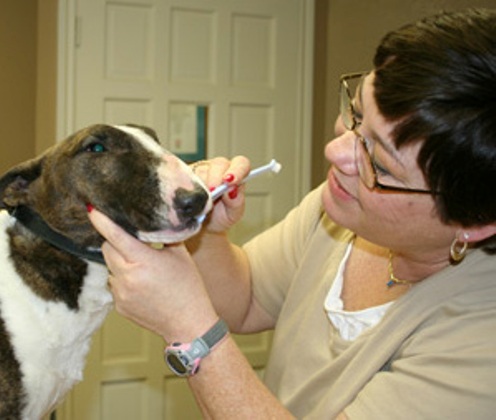
- Brushing your pet’s teeth daily with an approved toothpaste for pets is still the best way to remove the plaque. We recommend the CET toothpaste here at Main Street.
- For the few pets that will not tolerate brushing. There are other products that are less labor intensive and can help reduce plaque and tartar build up.
- CET chews are a rawhide product that contains an enzymatic cleaner. Giving your pet a CET chew 3-4 times a week can help reduce plaque build up but will not remove tartar.
- Science Diet Oral Care and Science diet T/D are designed to help scrape off the plaque as the pet chew. While these diets are extremely effective in removing plaque, they must be fed daily in order to help prevent tartar buildup. If you cannot routinely brush your pet’s teeth, you should consider feeding your pet one of these Science Diet products.
- For more severe periodontal disease the doctor may prescribe CET gel. This is a prescription product, which is applied daily at first and then once weekly long term to help prevent further damage to the tooth by bacteria.
- Finally, we can apply Ora-Vet to your pet’s teeth. Ora-Vet leaves a thin barrier on the tooth surface that prevents plaque and bacteria from attaching to the tooth. It leaves a very smooth finish to the tooth. We will also send home Ora-vet Home Care that is applied once weekly. Ora-Vet not only can help reduce the frequency of professional dental cleaning but also the amount of time required to perform a dentistry procedure therefore reducing the time your pet is under anesthesia.